
La donna che Francesco chiamava fratello
By friar Bill Short, OFM.
The final days of St. Francis are remembered through the stories of those who gathered around him. Brother Bill Short, OFM, recounts the remarkable role of Lady Jacoba of Settesoli, whose friendship with Francis earned her an extraordinary place among the brothers at the Portiuncula.
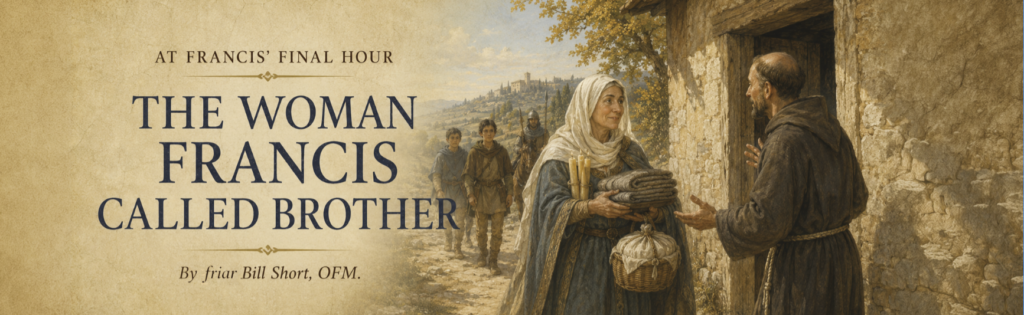
Lady Jacoba of Settesoli, a wealthy widow of Roman nobility and a long-standing close friend of Francis, was among the brothers to visit Brother Francis at his bedside. He had asked that a letter be sent to inform her of his impending death. He included in the letter a request that she bring some gray cloth, useful for a burial shroud, candles, and a certain sweet confection made of almonds and honey, called mostacciolo, which she would always make for him whenever he visited her in Rome. However, before the letter could even be sent, moved by divine inspiration, she had already arrived at the little house of the Portiuncula where Francis was nearing his final hour. She had brought with her the items Francis had requested.
She came with her sons, Giovanni and Giacomo, and an armed escort, essential for travel along dangerous roads in those days. When the group arrived, the brother who answered the door was at a loss. Women were forbidden within the cloister of a male religious community, so what should he do? Francis quickly solved the problem for him, saying that the rule forbidding women there did not apply in the case of this noble lady, as she should actually be called “Brother Jacoba,” as if just another member of the fraternity gathered there.
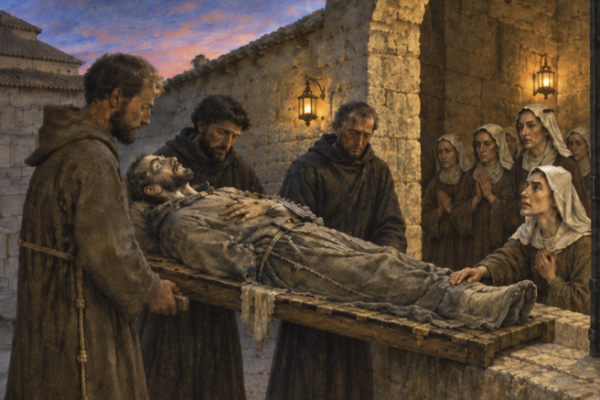
She remained with her dying friend until his passing on the following Saturday evening, and she even helped to prepare his body for burial. She convinced Brother Elias, the Minister General of the Order, that the marks they observed on the holy man’s body were not disfiguring but beautiful, and insisted that the body with its marks should be visible to all who attended the funeral. Thus, thanks to her, we have the complete description of those marks (or stigmata) by witnesses who observed them on the saint’s body before his burial.
After his death, she contributed funds to help build the burial church ordered by Pope Gregory IX, who had canonized Francis in 1228. Many years after her death, she was buried in the new Basilica that had been built over the tomb of Francis in Assisi. Her remains today lie enclosed in a metal urn set against the wall of the crypt, directly facing the sarcophagus containing the body of her friend. A beautiful fresco by the artist Simone Martini decorates a side wall of the Lower Church of the Basilica, portraying her in the white veil of a widow, with a halo containing the figures of seven suns (in Italian, sette soli, a reference to her name).
(We are indebted to Brother Thomas of Celano, his earliest biographer, who narrates this event as one of the “miracles” surrounding the death of St. Francis. In a little-known Treatise on the Miracles of Saint Francis, this story is listed in the midst of healings and other miracles about the death of Brother Francis on October 3, 1226.)