

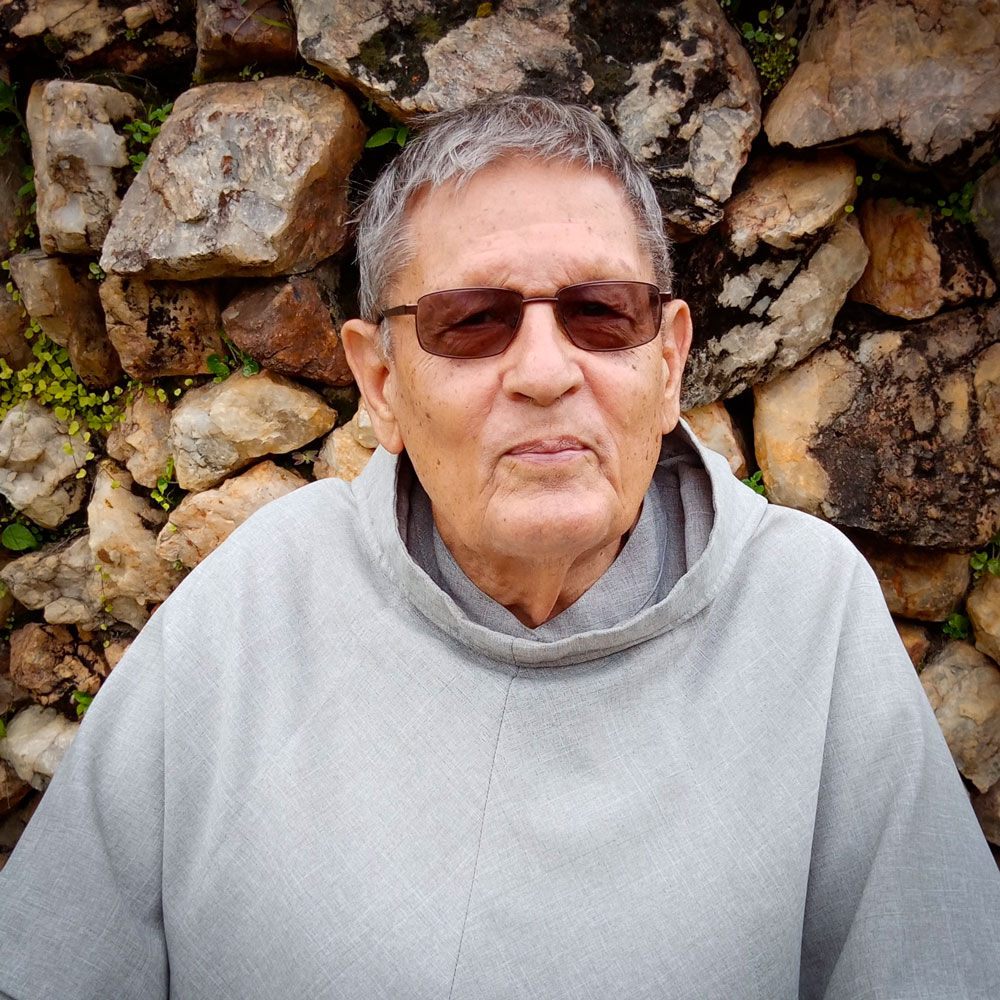
Brother Tony Droll, OFM Conv., was born on May 20, 1937, into a strong Catholic family as the third of five children. Formed from childhood in a deeply Franciscan environment, he attended primary school with Franciscan sisters and later entered Mount St. Francis Minor Seminary in 1951, where he was taught entirely by Franciscan priests. Although encouraged to pursue the priesthood, he remained steadfast in his vocation to become a Franciscan brother. He entered St. Anthony Novitiate in Angola, Indiana, and professed his first vows on July 17, 1956.
Desiring to serve as a missionary in Northern Rhodesia, he was first assigned to manage the dairy farm at the newly acquired seminary in Chaska, Minnesota. After nine years, his long-awaited mission call arrived, and in April 1965 he was sent to the newly independent country of Zambia. Assigned to a remote rural mission, he spent more than a decade teaching in the Franciscan school and assisting the Lunda people in developing sustainable ways to improve their lives.
In 1977, he studied integral development in Ireland. Upon returning, he helped respond to a massive malnutrition crisis as more than 10,000 refugees fled the Angolan war into Zambia. Working alongside the United Nations, he coordinated food relief and spearheaded the digging of hundreds of fishponds as a long-term solution to hunger.
Soon after, he was called into emergency ministry during the Rhodesian war, assisting thousands of displaced high school boys. He helped secure essential food and supplies until the conflict ended in 1980, when he was able to accompany the boys safely back to their newly independent homeland of Zimbabwe. Physically and spiritually exhausted, he took a sabbatical at Saint Louis University and completed summer studies at St. Bonaventure University, where he trained in Franciscan formation. Returning to Zambia, he served in the formation house preparing postulants for Franciscan life.
After thirteen years, Brother Tony transferred to Garneton, Kitwe, where, alongside Fr. Juniper Cummings, he recognized the urgent need for education among hundreds of impoverished village children. His vision led to the founding of a school that grew from a small community program into a thriving secondary institution. By 2021, the school educated more than 600 students, staffed by 49 trained teachers and supported by three Franciscan friars, continuing the mission he helped begin decades earlier.