
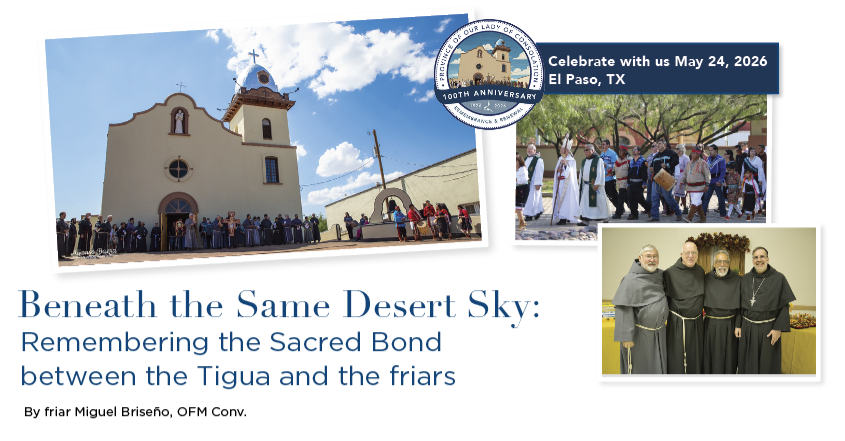
The desert sun rises over Ysleta del Sur, casting its first light on the adobe walls of Our Lady of Mount Carmel Parish. Here, faith and culture have intertwined for centuries—ever since the Tigua people journeyed south from their homeland with Franciscan friars at their side. When our friars returned in 1991, they found not a new mission to begin, but a sacred trust to renew. What began with friar Donald Adamski and his companions has become a lasting relationship rooted in respect, healing, and shared history—a living reminder that the Franciscan story in the Southwest is still being written, one generation at a time.
During the Pueblo Revolt of 1680, the Tigua were displaced from their native homeland in northern New Mexico. Accompanied by Spanish soldiers and Franciscan friars, they traveled south to establish a new homeland and pueblo called Ysleta del Sur—today considered the oldest continuously existing community of faith in Texas. The Franciscans remained with the tribe until the arrival of the Jesuits, who ministered from 1881 to 1991. When the Jesuits departed, the Diocese of El Paso briefly supplied priests until the friars of the Custody of Our Lady of Guadalupe assumed responsibility in June 1991.
It was not by coincidence that the Conventual Franciscan presence began just before the Feast of St. Anthony—the patronal feast of the Tigua people. Friar Donald Adamski, OFM Conv., was the first Conventual friar named pastor of Our Lady of Mount Carmel, which included the mission church of San Antonio de Ysleta del Sur. Joining him were friar Noel Kramer as associate pastor, friar John Weber working in the diocesan tribunal, and friar Philip Ley, then Custos, in residence. These four friars laid the foundation for our renewed Franciscan presence among the Tigua Pueblo and the wider parish community.
During his second term as pastor, friar Donald was joined by a young deacon, friar John Stowe—later ordained priest and eventually appointed Bishop of Lexington, Kentucky. Together they helped to heal long-standing wounds within the community, restoring trust where disrespect and misunderstanding had lingered since the Jesuit years. When friar Donald’s tenure concluded, friar John Stowe succeeded him as pastor, continuing to build upon the wisdom and compassion of his predecessor.
Friar Charles McCarthy followed as pastor, bringing a deep appreciation for the multicultural richness of Our Lady of Mount Carmel. His love for the Tigua Pueblo led him to immerse himself in their history, culture, and traditions, strengthening the bond between parish and people. When his time as pastor ended, friar Charles deliberately ensured a smooth transition for his successor, introducing parish leaders and encouraging continuity. That successor was friar Miguel Briseño, who, like the friars before him, has sought to honor the wisdom and faith inherited from generations of both Tigua elders and Franciscan shepherds.
From those first friars who journeyed through the desert centuries ago to those who continue to serve today, the story of Our Lady of Mount Carmel is one of endurance, reconciliation, and hope. The Franciscan presence that began alongside the Tigua endures still—building upon the wisdom of the past and walking together toward the future. In Ysleta del Sur, memory is not just recalled—it is lived daily in prayer, in friendship, and in the Franciscan spirit that still binds friars and Tigua together beneath the same desert sky.